Skip to content

Hydro-Vacuum TSC

Sewage pumping station with separation of solids

Wastewater pumping stations with separation of solids.

Talk to an expertSee how it works

Hydro-Vacuum TSC sewage pumping station with separation of solids

The challenge

Frequent failures generate high operating costs.

The use of pumps with very large free passages only partially eliminates these problems, while increasing energy use and pumping costs. Pumps with large passages typically have relatively low energy efficiency.

  • Clogging of gravity and pressure pipelines
  • Rotting of sewage in retention tanks
  • Blocking or damage of pump impellers
  • Frequent failures and high operating costs

Wastewater pumping stations with separation of solids address common problems in sanitary and combined sewage systems. Solids and trailing material in the pumped medium, together with low sewage hydration, can cause pumps to malfunction and require servicing or replacement.

The TSC design separates solids before wastewater passes through the pumps and accelerates sewage rotation in the retention tank. This allows pumps with narrower hydraulic channels and higher energy efficiency to be used.

See how solids separation works

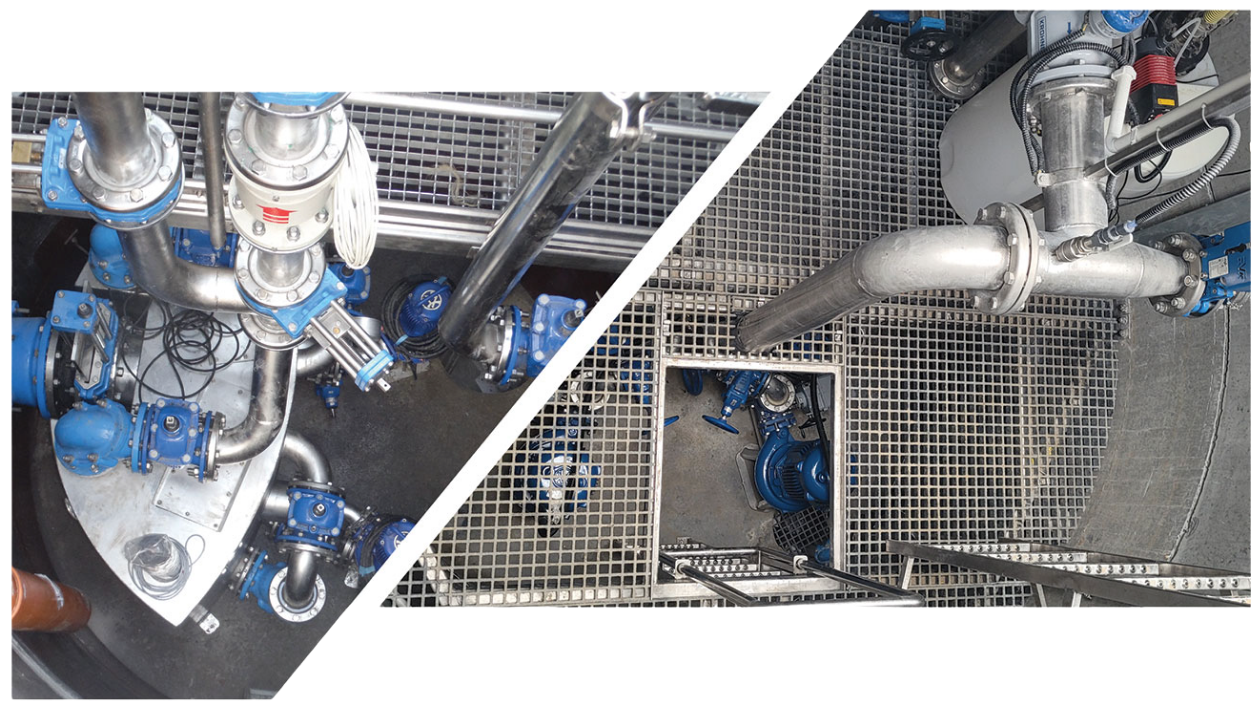
TSC pumping station pipework and pumps installed below a grated service platform in a dry chamber.

Benefits

Why operators choose solids separation

Reliability

Pump protection

Pump protection - thanks to the use of a solids separation system, complete elimination of clogging and blocking of pumps with solids contained in sewage

Fewer interventions

Reducing the occurrence of emergencies and the number of interventions by employees operating the facility

Continuous operation

Possibility of continuous operation of the device even in the event of probe and/or controller failure - additional alarm sensors

Costs and efficiency

Lower energy consumption

Possibility of using pumps with smaller free passages, lower power and higher efficiency = lower energy consumption of wastewater transport

Lower operating costs

Lower operating costs - reduction of energy consumption costs (high-efficiency pumps), minimization of the number of visits to the facility (reduction of failure states), elimination of damage to the elements of pump construction and hydraulic system – elimination of spare parts costs

Working environment

Comfortable operation

Comfortable operation - installation of the retention module of the pumping station with separation of solids in a dry external body with the possibility of access to its interior during operation of the device

Less contact with sewage

High comfort of work for service technicians and operators by limiting direct contact with sewage as much as possible

Engineering and origin

In-house development

Construction developed by engineers from the Research and Development Department of Hydro-Vacuum S.A.

Patented design

The pumping station with separation of solids has patents of the Polish and European patent offices

Award-winning FZ pumps

The pumping stations are equipped with award and medal winning high-efficiency FZ-type pumps manufactured by Hydro-Vacuum S.A.

Made by Hydro-Vacuum

Polish-made product - all manufactured in the parent factory of Hydro-Vacuum S.A. in Grudziądz, comprehensiveness of realization by Hydro-Vacuum S.A - selection, production, delivery and assembly of the device as well as after-sales support (technical and service)

Advantages of sewage pumping stations

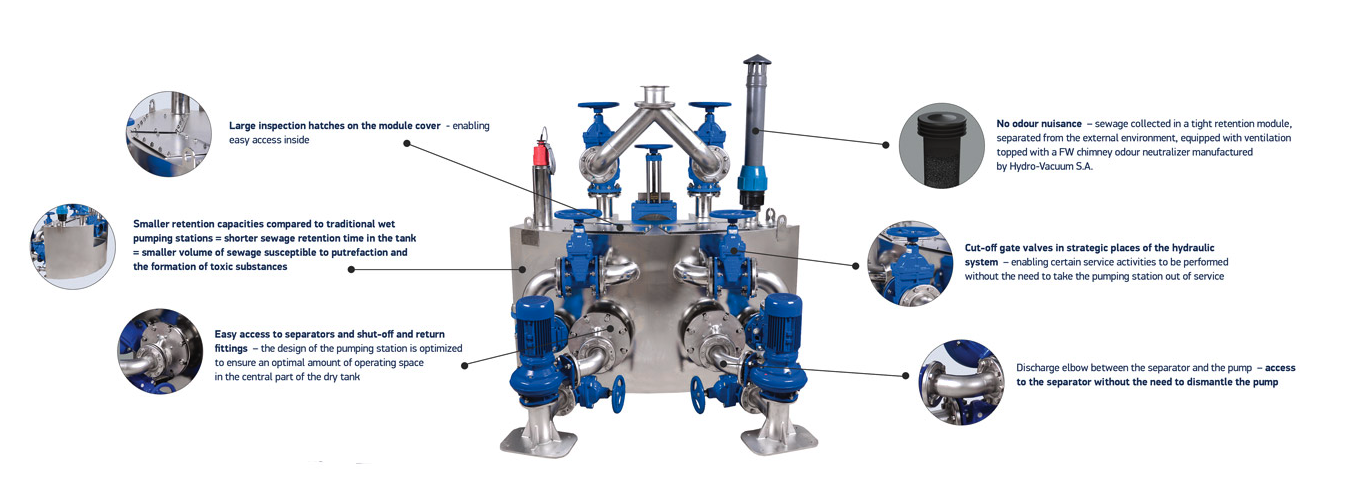
Annotated Hydro-Vacuum TSC sewage pumping station showing key construction and service features.

Principle of operation

How it works, in four steps

1

Inflow

In pumping stations with solids separation, wastewater flows into a pumping tank located in a dry chamber, and is then distributed to individual separators.

2

Separation

From the separators, the treated wastewater devoid of solids, sludge and trailing elements flows by gravity through the hydraulic elements of the pumps into the pumping station tank.

3

Pumping

The activated pump sucks the treated sewage and forces it into the separator located in the axis of the pump's discharge port.

4

Self-cleaning

During each pump start-up the separator is "self-cleaning".

Principle of operation

In a classic (wet) pumping station, wastewater fed by a gravity sewer flows directly into a retention tank. In pumping stations with solids separation, wastewater flows into a pumping tank located in a dry chamber and is then distributed to individual separators. From the separators, the treated wastewater devoid of solids, sludge,  and trailing elements flows by gravity through the hydraulic elements of the pumps into the pumping station tank. When any of the pumps is running, the wastewater flows only to the separator connected to the non-working pump.

The set sewage levels in the compressor station tank are controlled by means of an ultrasonic meter (other types of sensors can be used as an option). After receiving a signal that the set sewage levels in the tank have been reached, the protection-control device starts or stops the relevant pumps. The activated pump sucks the treated sewage and forces it into the separator located in the axis of the pump's discharge port. The energy of the pumped wastewater stream entrains the solids in the separator, directing them into the pumping station's discharge pipeline.

The overpressure created during pumping closes the wastewater return flow to the pumping station tank. During the pump cycle, wastewater flows into the tank through the second separator and the hydraulic system of the non-working pump. When the lower preset level of wastewater in the tank is reached, the pump is automatically turned off.

The design of the separator (a system of specially shaped rod baskets) means that the pumping station can operate continuously without requiring additional operations to remove accumulated pollutants. During each pump start-up, the separator is "self-cleaning". The hydraulic system of the pumps, which does not have direct contact with solids, and in particular with dragged solids, is not exposed to clogging.

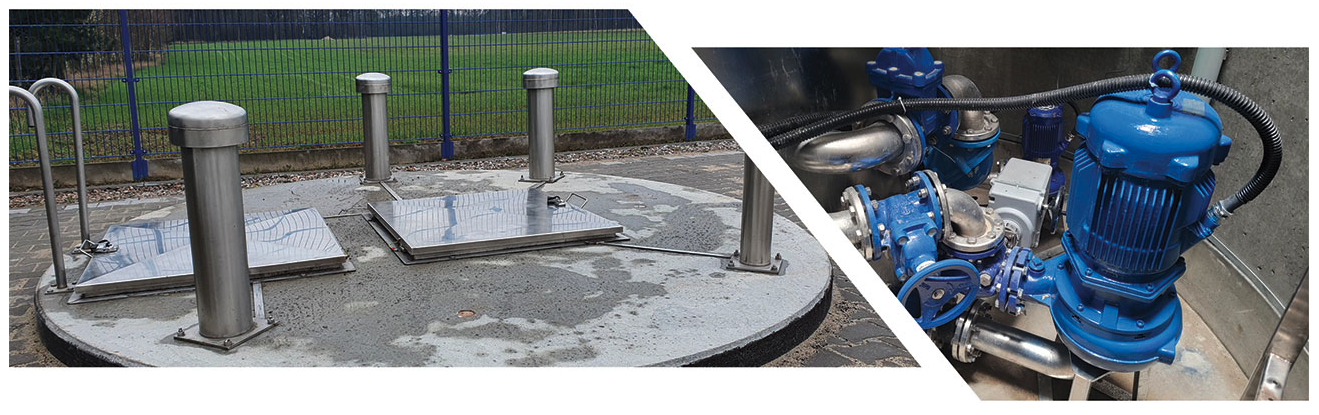
Outdoor access covers and pump equipment inside a Hydro-Vacuum TSC sewage pumping station.

Construction

A complete, fully automated unit

  • Retention module with distributor, emergency overflow and inflow/outflow hydraulic system
  • High-efficiency FZ-type pumps
  • Hydraulic and mechanical attachments
  • Shut-off and non-return fittings
  • Level sensors: ultrasonic or hydrostatic, plus float alarm sensors
  • UZS safety and control device

Choose your solids separator

Option A

Two-channel flap separator

Separating elements in the form of flexible filtering flaps.

Option B

Basket separator

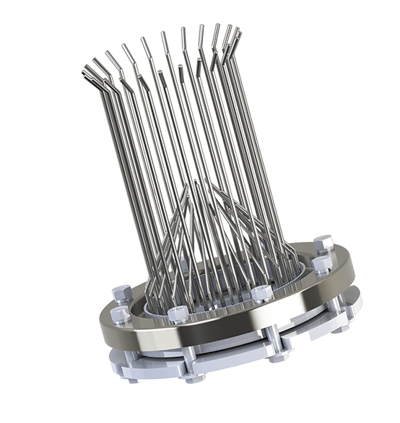
Separating elements in the form of flexible rods forming a filtering basket.

Installed in a dry tank with

LadderSupply-exhaust ventilation with duct fanLightingDrainage installation with FZ drainage pump

Check the TSC standard specifications

Animated illustration of the Hydro-Vacuum TSC sewage pumping station

Savings

Lower costs across the whole lifetime

Electricity

Lower electricity consumption – higher efficiency pumps

Service interventions

Reduction of costs due to service interventions - less frequent visits to the facility

Spare parts

Elimination of spare parts costs - removal of causes of failure of pumps working with wastewater medium

Components

reduced cost of replacing components - longer life of equipment components due to materials used - no corrosion

Technical data

TSC standard series

Sewage inflow rate4–400 m³/h
Diameter of the discharge pipeline80–250 mm
Num. of pumps2–8 pcs.
Retention capacity0,1–11,0 m³
Pumps typeFZ.2–FZ.8
Min. tank diameter1500–5500 mm

16 standard sizes. Stations beyond the standard series are available on individual request.

View the complete technical data

Full specifications

Specification TSC*
Sewage inflow rate (m3/h) 4-400
Diameter of the discharge pipeline (mm) 80-250
Num. of pumps (pcs.) 2-8
Retention capacity (m3) 0,1-11,0
Pumps type FZ.2-FZ.8
Min. tank diameter (mm) 1500-5500**
* on individual request the possibility to make a compressor station with parameters exceeding the standard series of types
**depending on the type size of the TSC compressor station - there are 16 types of compressor station sizes available in the standard series

Components and control

Pumps, materials, control and certification

FZ pumps

The sewage pumping station with separation of solids is equipped with alternately operating FZ pumps with a highly efficient hydraulic system and a reliable drive transmission system.

Discuss pump selection with an expert

  • Channel impellers with high-efficiency electric motors in the IP68 version. The motor can operate in dry and submerged conditions.
  • Built-in thermal and humidity sensors protect the pumps.
  • A wide range of pump types and sizes allows optimal selection to suit the investment conditions and the customer’s needs.

Automatic control

The operation of the sewage pumping station with separation of solids is fully automatic using a set of control devices.
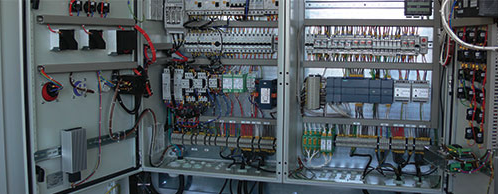
Electrical control cabinet for automatic operation and alarm monitoring of a Hydro-Vacuum TSC pumping station.


  • A safety and control device and liquid level sensors control the operation.
  • Safety and control devices manufactured by Hydro-Vacuum S.A. include acoustic and optical signalling of alarm states.
  • A remote monitoring system enables ongoing supervision, management and comprehensive remote supervision of water and sewage infrastructure devices.

Module and fittings

The retention module, solids separators and piping are made of stainless steel with high corrosion resistance.
  • Non-return and shut-off valves are made of materials intended for use in sanitary sewage.
  • Non-return valves ensure reliable operation and effective transport of wastewater containing solids.
  • The valves have CE marking for compliance with the PN-EN 12050-4 standard.

Stainless steel basket separator with flexible rods for separating solids in a TSC sewage pumping station.


Certificates and declarations

The TSC sewage pumping station with separation of solids has a Declaration of Performance and CE marking for compliance with the harmonized standard PN-EN 12050-1:2002.

This standard applies only to wastewater pumping stations with separation of solids intended for discharging sewage from places in buildings and their surroundings, located below the flood level to protect buildings and their surroundings against reverse flow.

For all other applications and locations of wastewater pumping stations with separation of solids, national regulations arising from the Act on Construction Products dated 16 April 2004 shall apply. The TSC wastewater pumping station with separation of solids also has a National Declaration of Performance and marking with a construction sign.
CE marking, Polish product mark and management-system certification marks for Hydro-Vacuum TSC pumping stations.


Product images

Hydro-Vacuum TSC sewage pumping station, product view 1
Hydro-Vacuum TSC sewage pumping station, product view 2
Hydro-Vacuum TSC sewage pumping station, product view 3
Hydro-Vacuum TSC sewage pumping station, product view 4
Hydro-Vacuum TSC sewage pumping station, product view 5
Hydro-Vacuum TSC sewage pumping station, product view 6
Hydro-Vacuum TSC sewage pumping station, product view 7
Hydro-Vacuum TSC sewage pumping station, product view 8
Hydro-Vacuum TSC sewage pumping station, product view 9
Hydro-Vacuum TSC sewage pumping station, product view 10
Hydro-Vacuum TSC sewage pumping station, product view 11
Hydro-Vacuum TSC pumping station with rectangular stainless steel tank and blue pumps in the factory

Patented design

Patents of the Polish and European patent offices.

Award-winning FZ pumps

High-efficiency FZ-type pumps manufactured by Hydro-Vacuum S.A.

Made by Hydro-Vacuum

Manufactured at the parent factory in Grudziądz, Poland.

Find the right pumping station for your project

Tell us about your sewage inflow, site conditions and project requirements.